High-tolerance floor grinding is the foundation for operational excellence in automated and industrial environments. In facilities that rely on advanced systems or around-the-clock activity, the condition of your floor dictates how efficiently everything runs.
DC Flooring specialises in floor flatness testing and associated high-tolerance floor grinding for concrete floor applications, applying industry-leading techniques to support heavy-duty, high-precision, and machine-driven operations throughout Europe. By focusing on the technical needs of modern industry, we provide solutions that support productivity, extend equipment life, and maintain standards where it matters most.
What is High Tolerance Grinding?
High-tolerance grinding is a controlled process that brings a concrete floor slab to precise flatness and levelness targets demanded by automation and high-performance activity. Unlike traditional methods, our high-tolerance grinding system employs machine floor grinding, guided by advanced instruments to deliver superflat floors tailored for exacting requirements.
This approach mitigates issues caused by high or low spots and delivers a platform ready for industrial automation, VNA forklifts, and all other material handling equipment. Even small deviations can impact safety or machine lifespan, so strict attention to detail during corrective grinding is essential for reliability.
Typical environments where this is crucial include:
- Automated warehouses
- AGV/AMR zones
- VNA warehouses
- Data centres
- Clean rooms
- Precision factories

Why Choose High Tolerance Floor Grinding?
High tolerance floor grinding is critical in environments where operational reliability can’t be left to chance. Automated guided vehicles, robots, and high-density storage solutions rely on perfectly level and consistently flat floors, especially in narrow aisle racking or complex manufacturing.
Investing in professional ultraflat floor grinding minimises costly machine faults, ensures safer working conditions, and reduces the maintenance burden. By selecting a specialist flooring contractor, you reduce the risk of unplanned downtime, material damage, and disruption—benefits that support safety, efficiency, and operational growth for your business.
High-Tolerance Grinding Technical Specifications and Measurement Criteria
Delivering reliable, compliant floors is a matter of precision and process. At DC Flooring, we deploy advanced floor grinding equipment and cutting-edge digital measuring technologies during every phase. Key parameters like levelness, floor flatness, and surface roughness are continually monitored and calibrated to specification.
This disciplined methodology ensures outcomes are fully aligned with both industry standards and client-specific needs. The focus remains on measurable, objective results: each project is documented and verified, guaranteeing a performance-driven substrate for future operations.
Key Metrics We Monitor
Our team monitors several critical criteria to maintain performance benchmarks throughout the entire grinding operation:
- Flatness (F-value, FF/FL values): We assess the consistency of the slab to ensure superflat floors meet specified tolerances for robotics, very narrow aisle forklifts, and precision automation.
- Levelness/tolerance (mm per metre, mm over area): Exact measurements at regular intervals prevent slopes or uneven sections, allowing for seamless material flow and accurate equipment alignment.
- Surface roughness (Ra, Rz): Correct traction prevents unnecessary tyre wear while maintaining required anti slip properties, ensuring operational safety and efficiency.
- Joint and crack integrity (width, depth): Properly finished joints reduce wear and vibration on wheels, improving both vehicle safety and the longevity of the floor slab.
- Dust and debris control (vacuum systems): Industrial floor grinding with integrated vacuum extraction keeps environments safe, promotes longer machine life, and supports post-installation cleanliness.
- Measuring instruments: Laser profilers, digital levels, straightedges, and profile scanners are used at each step to document that project requirements are being met.
Typical Specification Ranges for High Tolerance Floor Grinding
We tailor our technical targets for every project, coordinating closely with your consultant and aligning with your unique floor design demands as a trusted floor survey and grinding company.
| Measurement Parameter | Typical Specification (High Tolerance) | Unit | Notes |
|---|---|---|---|
| Flatness (FF value) | e.g., FF 60–80 / FM2 | FF index TR34 | Suitable for automation/robotics |
| Levelness deviation | ≤ ±3.0 mm per 3 m | mm/m | Ensures minimal slope deviations |
| Surface roughness (Ra) | 30–50 μm | μm | Balances traction & smoothness |
| Joint width/tolerance | ≤ 20 mm width, filler flush with ≤ 2 mm step | mm | Minimises wheel impact |
| Vertical deviation (dip/warp) | < 2 mm over 5 m | mm | Prevents ride-shock for AGVs |
| Dust residual (after prep) | < 0.5 g/m² | g/m² | Ensures clean substrate |
By adhering to these industry-proven benchmarks, we achieve a heavy-duty floor grinding result that transforms each concrete slab into a resilient, dependable asset. These standards are not minimums; they are the requirements for facilities that expect consistent, peak performance from their floor over the long term.
How We Achieve High Tolerance and Deliver Premium Floor Quality?
Quality outcomes depend on a structured, stepwise process. Our methodology is transparent, measurable, and focused on providing long-lasting, certified results that enhance your operations. DC Flooring integrates advanced monitoring and consistent communication from first inspection through post-installation verification. Every project phase (from site assessment to maintaining compliance through other trades) ensures your investment delivers value and resilience, not just a good first impression.
- Pre-survey & site assessment: We begin by thoroughly inspecting the site and identifying any areas that could impact finished tolerance. Our assessment looks for latent defects, substrate conditions, and client requirements, forming the groundwork for a fit-for-purpose execution plan. We take into consideration the MHE’s that are going to be used, the height of the racking that they will be working at and the paths they will follow.
- High Tolerance Surveying: Our equipment is the most accurate floor profiling technology on the market. With the detailed data that it produces we can determine the most cost effective solution to bring your floor to the precision standard that it needs.
- Subfloor preparation: Prior to heavy duty floor grinding machine, we deep clean, repair, and stabilise all relevant surfaces. Identifying contaminants, filling cracks, and correcting minor imperfections optimises the base layer, ensuring the grinding phase achieves its full effect.
- Grinding phase: Our technicians use precision-controlled grinders and aligned laser tracking to systematically bring the slab into specification. Material is removed in governed increments, and progress is continually checked for uniformity and compliance.
- Monitoring & measurement during grinding: Real-time checks with advanced measurement instruments maintain specification compliance as each zone is completed, enabling quick corrections when deviations occur.
- Post-finish QA verification: A final survey of the finished slab records all key criteria, with results delivered as validation to the client and supporting documentation for regulatory and operational reference.
- Coordination with next phase to maintain tolerance: Integration with follow-on trades, whether for subsequent flooring systems or marking, secures lasting results and preserves all achieved tolerances.
This approach guarantees comprehensive, consistent delivery; each step is designed with accountability, traceability, and operational continuity in mind.
Benefits of High Tolerance Grinding
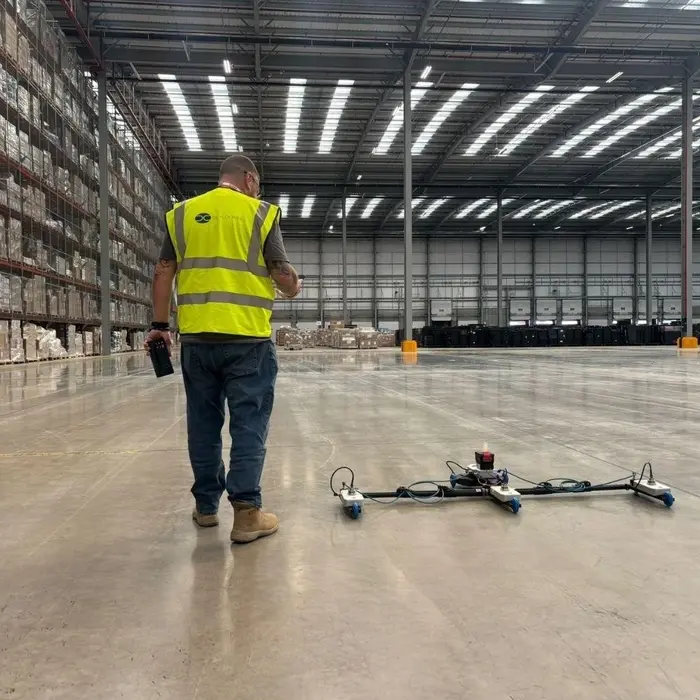
Floor flatness testing and high-tolerance grinding deliver quantifiable advantages, directly impacting operational reliability, cost management, and personnel safety. It secures business continuity and supports future system upgrades, making it a strategic investment for facilities of all sizes and scopes.
- Increased uptime and reliability for automated systems: Superflat, certified floors prevent interruptions and errors for machine-guided vehicles, allowing for greater throughput, reduced troubleshooting, and a higher level of automated control.
- Reduced maintenance costs: Well-ground floors prevent unnecessary vibration, equipment fatigue, and damage, meaning reduced spend on wheel replacement, bearings, alignments, and repairs across all rolling stock.
- Superior safety: Flat, undistorted floors significantly reduce the risk of accidents or equipment failures, creating a safer environment for personnel, vehicles, and valuable stock.
- Enhanced floor lifespan and durability: By removing surface weaknesses and working below damaged material, we extend usable floor life and strength, amply resisting high loads typical in modern logistics or production.
These combined benefits mean the initial cost of these works is soon outweighed by reduced lifecycle costs, maintained compliance, and stronger operational performance for years to come.
Applications and Suitability of High-Tolerance Floor Grinding Services
Our service is relied on in any setting where small variations in level or surface detail control downstream outcomes. We work with facility managers, in-house engineers, MHE integrators and consultants to support new builds as well as upgrade projects, ensuring both legacy and modernised environments are fit for purpose.
- Automated warehouses & logistics hubs (AGVs/AMRs): Consistent flatness is key for fleet AGV performance and reliability in busy, data-driven hubs.
- Precision manufacturing & assembly plants: Stable, level surfaces maintain alignment and calibration for robotic arms, CNCs, and control machinery.
- Clean rooms & data centres: Flat subfloors are required for stable, raised floors in IT and pharma, supporting sensitive systems and protecting investments.
- Heavy vehicle traffic areas (aircraft hangars, distribution centres): Durable, level slabs distribute load evenly and avoid stress points developing beneath tyres or undercarriage.
- Retrofitting older slabs vs new builds: Our methodology suits both, supporting upgrades for new automation without total floor replacement.
Why We are Leaders in High Tolerance Grinding Services and Solutions?
Not all floor grinding companies can truly deliver on precision promises. DC Flooring combines sector experience, best-in-class equipment, and a commitment to measurable outcomes that consistently set the standard in industrial and automation environments. Our clients count on:
- Complete European coverage and capability to deliver efficient results even in challenging, high-volume, or time-sensitive environments.
- Dust-free vacuum grinding systems that secure health, visibility, and post-survey cleanliness for your facility.
- Highly experienced teams using certified procedures and producing detailed, digital reporting for clear, defensible results.
- Seamless integration with further fit-out services, enabling smooth transitions between grinding, repairs, and finishing.
- Uncompromising focus on specification, traceability, documentation, and a clear return on your flooring investment.
Our European coverage enables us to handle large areas with minimal disruption, supported by dust-free vacuum grinding systems that make the process safer, cleaner, and faster. We deploy highly experienced teams using certified equipment and provide full measurement reports to ensure clarity and confidence. Our grinding services integrate seamlessly with our complete flooring solutions: from surveying and grinding through to polishing and marking – delivering a smooth, end-to-end process. With a strong focus on precision, quality assurance, documentation, and clear ROI, we help clients achieve reliable, long-lasting results.
FAQs
What is the difference between standard floor grinding and high tolerance grinding?
Standard floor grinding primarily smooths a surface, removes old coatings, or prepares it for a new finish. High-tolerance grinding is a far more precise discipline. It employs high precision floor profiling equipment and continuous measurement to methodically re-profile a concrete slab, correcting its flatness and levelness to meet stringent, pre-defined specifications. This methodical approach is essential for ensuring the optimal performance and safety of automated systems and specialised MHE in demanding industrial environments.
What flatness and levelness tolerances can your high tolerance grinding achieve?
We can achieve extremely tight tolerances tailored to your specific needs. For example, we regularly deliver floors with the highest of flatness and levelness ratings, which are suitable for any advanced robotic systems. Our floor profiler can measure to any floor tolerance, these include standards such as ASTM, DIN, TR34 and all others. We work with you to define the exact specifications required by your machinery and provide a certified report to prove the targets were met.
How long does a high tolerance grinding job typically take and how disruptive is it?
The timeline depends on the size of the area and the condition of the existing slab. However, we work efficiently to minimise downtime. A typical project might take a few days to a week. We use dust-free grinding systems to keep the air clean and reduce mess. We can also schedule work in phases or during off-peak hours to ensure your operations can continue with as little disruption as possible.
Can high tolerance grinding be applied to existing slabs in operational facilities?
Yes, absolutely. A large portion of our work involves retrofitting existing floors in live operational environments. We are experts at working in active facilities with minimal disruption. Our dust control systems are critical in these situations, ensuring we can upgrade your floor to meet modern automation standards without contaminating your products or interfering with your day-to-day business. It’s a cost-effective way to prepare an older building for new technology.
Are there additional costs compared to standard grinding, and what justifies them?
Yes, there is an additional cost, and it is justified by the precision, technology, and guaranteed outcome. High-tolerance grinding requires more advanced floor flatness testing equipment, more extensive measurement and verification, and more highly skilled operators. The investment is justified by the significant return you get from reduced machinery maintenance, increased operational uptime, enhanced safety, and the extended lifespan of both your floor and your equipment.
How often should a high tolerance floor be inspected or re-ground?
High-tolerance floors should be inspected annually to ensure they remain within specification. Regular checks help identify any wear, damage, or deviations caused by heavy use or environmental factors. Re-grinding may only be necessary every 5–10 years, depending on the intensity of use and the condition of the floor. Proactive maintenance ensures the floor continues to support your operations effectively and prevents costly repairs or downtime in the future.