Hardness is a property of objects that is hard to change when they undergo different kinds of deformation. To measure hardness, you need a Mohs scale of hardness for floors and the right tools.
German geologist Friedrich Mohs created the first hardness scale. He catalogued minerals and created a scale to rate their hardness, determining that diamond is the hardest material.
Polished concrete is also quite hard, with a hardness rating between 6 and 7 on the Mohs scale. This rating may not directly relate to concrete’s strength, but shows an important connection.
The Importance of Measuring the Floor Hardness with the Mohs Scale Test
Measuring floor hardness using the Mohs scale is important for many reasons. It helps determine the durability and wear resistance of a surface. Knowing the hardness of a floor can guide decisions about flooring materials. It can also indicate how well the floor will hold up under heavy foot traffic. Harder surfaces usually resist scratches and dents better than softer ones. This information aids in maintenance planning and cost estimation for repairs.
Other Different Tests to Determine the Hardness of a Concrete Floor
Many tests can measure the hardness of materials, including the Knoop, Rosiwal, Shore, and Roswell tests. Each of these tests has its own scale. However, these methods are not suitable for measuring the hardness of cured concrete because they are specialised techniques in industrial mineralogy. For concrete analysis on-site, non-destructive and easy-to-use methods are needed, such as:
Rebound Test
This non-destructive test measures how well a concrete structural element resists impact. It uses a tool called Schmidt’s hammer or sclerometer.
The sclerometer’s weight is pulled back by a strong spring. When it hits the concrete surface, it rebounds, and this rebound is measured. The results are given in psi (pounds per square inch).
Today, digital sclerometers are available. They can store andanalysee a lot of data, creating tables with maximum and minimum values.
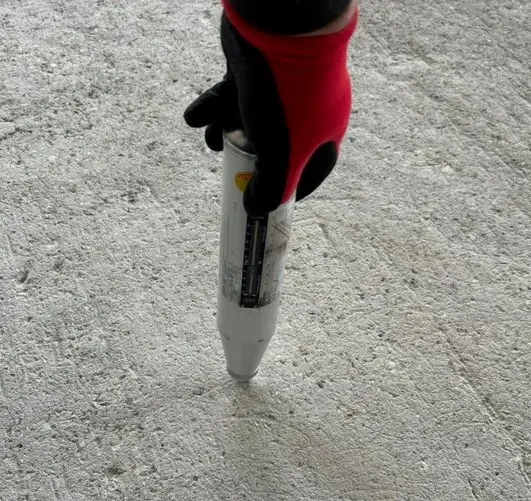
However, this method is not entirely reliable. Measurements can differ due to:
- The angle of the sclerometer relative to the concrete surface; it needs to be perpendicular for accurate results.
- Dust and coatings on the concrete can affect the readings.
- Aggregate and concrete reinforcing steel can improve the hardness value.
Scratch Test
The hardness scale measurement is a simple and cost-effective method, making it quite popular. It involves scratching the concrete surface with four pencils, each numbered from 2 to 9, each with a standardised point based on the Mohs scale.
The Mohs scale ranges from 1 to 10, with talc as the softest and diamond as the hardest. To perform the test, choose a pencil with a lower number, either #2 or #3. Press the pencil tip against the concrete and draw a line about 5 centimetres long.
The pencil that creates a noticeable scratch will indicate the concrete’s hardness according to the Mohs scale.
Improve Your Concrete Hardness
In industrial areas, it is crucial to keep concrete floors in good condition despite heavy machinery traffic. The floors need to be highly resistant to abrasion from load transport. Regular maintenance and treatment make the concrete harder and improve the surface for industrial use.
Factors Affecting the Hardness of Concrete
When working with concrete, several factors influence the strength of the final product. It is important to consider these factors to achieve the desired strength in fresh concrete, as they all impact the setting and formation process. Here are the top four factors that affect concrete strength.

- Concrete Grade
Concrete grade indicates the compressive strength of the concrete mix. Higher grades mean stronger concrete. Common grades include C25, C30, and C40. The mix ratio of cement, sand, aggregate, and water determines the grade. Using the right grade is essential for the intended application. A higher grade is recommended for places that endure heavy loads. Lower grades may be suitable for residential use where the load is not as heavy. Always assess the requirements before choosing the concrete mix.
- Curing
Curing concrete involves allowing it to age in a controlled environment to achieve desired properties like strength. Key factors include temperature, compaction, and humidity. The cement needs high moisture levels, around 85-90%, for proper hydration. Curing time affects the final product, with a general guideline of curing for up to 28 days for optimal results.
- Aggregate
Aggregate is an essential component of concrete. It includes materials like sand, gravel, or crushed stone. The size and quality of aggregate can affect the strength and durability of concrete. Coarse aggregate improves strength, while fine aggregate ensures good workability. The right mix is important for achieving the desired properties. Poor-quality aggregate can lead to issues like cracking and reduced lifespan. Always choose aggregate carefully based on the project’s requirements.
- Compaction
Compacting concrete during the setting process is crucial for its strength. Less compaction leads to more air pockets and voids in the concrete mix. This affects the overall strength, as poorly compacted concrete with 5 to 10% voids can lose 30 to 40% of its strength. It is important to achieve the right compaction for the specific project you are working on.
Choose DC Flooring for Professional Measurement of Your Floor Hardness
DC Flooring offers reliable and accurate measurements of floor hardness. Their team uses advanced equipment and proven methods to assess concrete durability. This helps clients make informed decisions about flooring options and maintenance. With years of experience, they provide expert advice tailored to each project. Choosing DC Flooring ensures that you receive precise data and quality service, which supports the longevity of your concrete surfaces.
FAQs
What is considered a hard floor?
Hard flooring is made from natural and synthetic materials that do not flex or bend when stepped on. Due to their solid, smooth texture, these surfaces are tough, long-lasting, and resist wear.
What is the Best Hard Flooring?
The best hard flooring options are those that offer durability and resistance to wear and tear. Popular materials include hardwood, laminate, tile, and vinyl. Each material has unique advantages. Hardwood provides warmth and elegance but can be susceptible to scratching. Laminate is more affordable and easier to install, making it a great choice for many homeowners. Tile is highly durable and moisture-resistant, ideal for kitchens and bathrooms. Vinyl combines comfort with versatility, available in many styles. Choosing the right flooring depends on the space’s specific needs and personal preferences.
How to use a Mohs hardness test kit?
Test in different areas of the floor for accurate results. There may be multiple pours in different spots, leading to varying outcomes.
Watch for signs of micro-topping, self-levelling, or patching compounds. Look for different colours, textures, or edge delamination for clues.
Learn about the aggregates in your area by doing a scratch test on stones that are exposed during grinding and polishing.
Keep the picks sharp and in good condition. The kit includes a small stone for dressing the tips.
The picks have very sharp points, so handle them with care.
Never place a loose pick in your pocket or clothing.
The picks and instructions are guidelines and do not cover every situation.
How to read the Mohs hardness scale?
The Mohs hardness scale is a simple tool for assessing the hardness of materials. It rates ten minerals from hardest to softest, with diamond at the top and talc at the bottom. Hardness is determined by seeing if a material can scratch another. For example, it is harder if a material can scratch something rated lower on the scale. This test is useful in many fields, including geology and material science. Understanding hardness helps in selecting materials for specific applications.