
Adding the coating to the flooring is the cherry on top after hard work. It makes the floor look flawless and provides the finish that makes everything look fantastic. However, a coating system sometimes fails, and when it happens, it’s a problem on multiple levels, not just the poor look.
When a coating system fails, you’re dealing with safety issues and structural integrity. You must fix the problem, and this is costly. You need to spend more time on the job, and the project has been prolonged much more than planned.
To avoid all this, you must obtain a pull off test for adhesion measurement.. This test can potentially save you money, time, and frustration, but even more importantly, it will keep your reputation as a contractor that always delivers a great product.
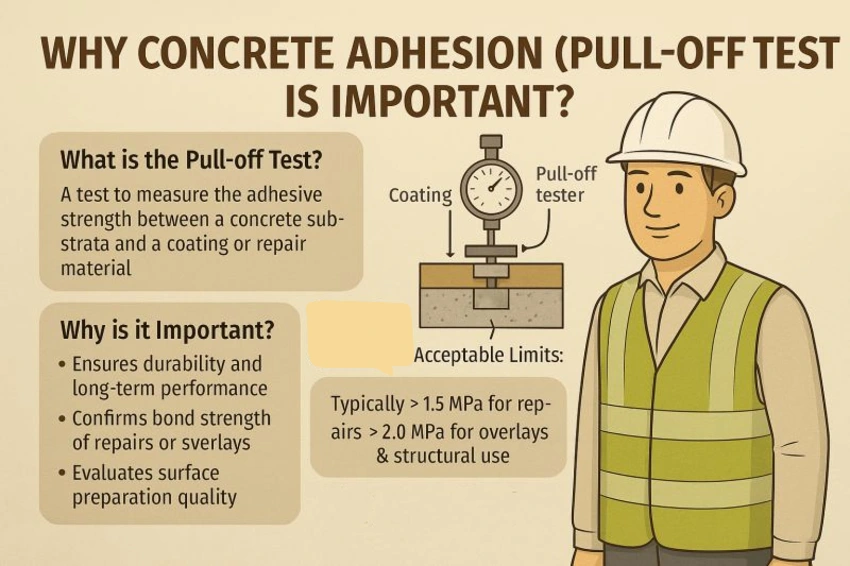
What is Pull-Off Adhesion Testing?
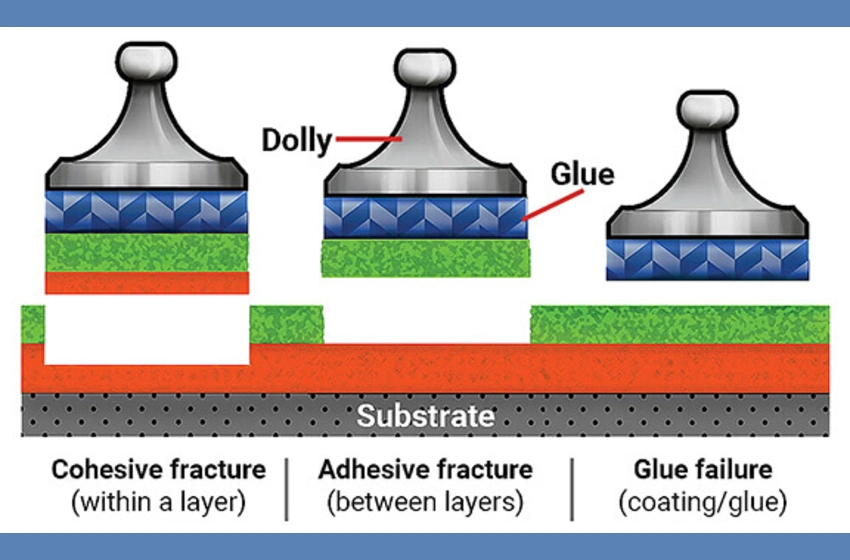
Pull-off adhesion testing measures the adhesive strength between a coating and its rigid substrate. Using a pull-off tester, a dolly is bonded to the surface with a suitable adhesive, often an epoxy adhesive or cyanoacrylate. Once cured, a tensile load is applied perpendicular to the surface until the coating detaches. This test identifies both the level of adhesion and the type of failure – whether it’s adhesive (between coating and substrate) or cohesive (within the coating layer itself).
Key steps and best practices
For a pull-off test to provide reliable results, conditions must be carefully controlled. Following best practice ensures accuracy and consistency.
- Check timing and conditions – Run the test only once the coating has fully cured according to the manufacturer’s instructions. Document the temperature and humidity during testing, as both factors influence adhesion results.
- Prepare the surface – Remove loose particles, dust, and contaminants without damaging the substrate. Record any surface cleaning or preparation steps performed before the test.
- Choose the right adhesive and dollies – Use only adhesives and test dollies recommended by the manufacturer to prevent skewed results.
Consequences
Ignoring adhesion problems can create multiple risks. From performance issues to legal disputes, the outcomes of poor bonding are serious.
- Early failure – Weak bonding causes peeling, blistering, and delamination, often leading to premature replacement.
- Safety hazards – Loose flakes, slippery patches, and uneven areas increase the risk of slips or trips.
- Contamination and disruption – Detached coating produces debris and dust that may damage machinery, storage racks, or goods.
- Costly downtime – Frequent repairs, shutdowns, and corrective maintenance increase operational costs.
- Warranty and compliance risks – Failed adhesion can void product warranties, cause project handover delays, and create disputes with clients.
Common signs of poor adhesion
Problems with adhesion often show up early if you know what to look for. Visual checks and simple tests can highlight weak areas.
- Blisters or lifting edges – Localised swelling, edge curling, or surface bubbles usually mean poor bond strength.
- Delamination patches – Entire sheets or partial areas detach from the substrate, which is noticeable through tapping or inspection.
- Surface dusting – Powdering on the surface suggests that the coating is losing its bond to the base material.
- Low test results – Pull-off strength values below specification during testing signal inadequate adhesion.
Typical causes
When adhesion fails, the reasons often trace back to preparation or environmental factors. Knowing the common causes helps prevent repeat issues.
- Moisture in the substrate – Residual damp or rising water vapour weakens bonding during application.
- Insufficient surface preparation – Poor profiling, laitance, grease, or curing residues prevent coatings from gripping.
- Trapped contaminants – Dust, curing agents, or release products beneath the coating interrupt the bond.
- Incorrect materials – Using the wrong primer, adhesive system, or incompatible products causes weak adhesion.
- Unfavourable conditions – Applying coatings outside the specified temperature or humidity range undermines curing.
How Does Pull Off Adhesion Testing Work?
The process starts by preparing the test area to ensure no contamination interferes with results. A dolly, sometimes called a pull stub, is attached to the surface of the coating using a strong epoxy or other suitable adhesive. After curing, a hydraulic or portable pull-off adhesion tester applies force perpendicular to the surface. The tensile stress at the point of failure is recorded, giving a direct reading of the bond strength in psi or MPa. The method reveals the actual adhesion properties of the coating and whether the adhesion characteristics meet project specifications.
Why Pull-Off Adhesion Testing is Mandatory for Flooring Systems?
Some flooring systems, like epoxy or resin finishes, are more fragile than others. They face traffic or chemicals when cleaned, so there’s a chance they break the bond after heavy use. The pull-off adhesion testing ensures the coating system will remain bonded. Without it, you risk a disappointing call from the customers stating that the flooring is damaged and you’re responsible for it.
Industry Standards for Adhesion Testing
International and national standards govern how adhesion testing is performed. BS EN 1542 is widely used in Europe for concrete substrates, ASTM D4541 (American standard) is common in the US, and ISO 4624 (EN ISO 4624) applies globally for various coating and substrate combinations. These standard test methods ensure consistency, accuracy, and compliance, allowing results to be compared against industry benchmarks.
- BS EN 1542 – Determination of adhesion by pull‑off for coatings on concrete.
- ASTM D4541 – Pull‑Off Strength of Coatings Using Portable Adhesion Testers (widely used alternative).
(Use the test standard agreed in the specification and record it in the report.)
Minimum Pull-Off Strength Requirements for Different Flooring Systems
Every flooring material requires a different approach. For example, the amazing epoxy needs a higher tensile strength, while the varnish, or the decorative coating, needs a lower strength. The bonding strength is usually specified by manufacturers, so following the instructions is the best way to do it. This will ensure the coating adhesion is suitable and done well.
When Should Pull-Off Testing Be Conducted?
Pull-off testing is not a one-time step – it should be integrated throughout the project.
- During surface preparation – Testing prior to applying flooring verifies that the substrate is clean, dry, and capable of supporting the coating. This helps detect contamination or structural weakness before any resin or epoxy is applied.
- After installation for quality assurance – Once the coating system has cured, testing the adhesion confirms the coating surface is performing as expected and meets contractual requirements.
- In refurbishment or repair projects – Older flooring may suffer from reduced adhesion strength of coatings due to moisture, wear, or chemical damage. Pull-off testing determines whether the surface can be recoated or requires complete floor removal.
Common Issues That Can Be Detected Through Pull Off Testing
When the test is performed, you may face various issues. Here are the most common ones:
- Inadequate surface prep – If a coating from the substrate separates too easily, it may be due to insufficient cleaning, grinding, or priming.
- Moisture problems – Excessive moisture in the substrate can weaken adhesion properties, leading to failure under tensile load.
- Substrate contamination or weakness – Oils, dust, or degraded concrete can interfere with adhesive properties, preventing the coating and substrate from forming a strong bond.
6 Key Benefits of Proper Adhesion Pull Off Testing
When you do proper adhesion pull-off testing, you will see multiple benefits. Here are three of them:
- Confirms surface durability against repeated traffic from forklifts, VNA trucks, and conveyors.
- Reduces dusting and loose debris that damage MHE, racking, and stored goods.
- Helps maintain flatness or tolerances by identifying surfaces prone to rapid wear and edge failure.
- Informs appropriate surface specification or remedial treatments (toppings, hardeners, coatings).
- Lowers maintenance, downtime, and lifecycle costs by preventing premature surface failure.
- Provides objective classification to industry standards (e.g., BS EN 13892‑4 / BS 8204‑2) for acceptance and quality control.
Who Needs Pull-Off Testing to Measure the Adhesion?
Pull-off testing is relevant to many roles across the construction and maintenance sectors. It is not limited to contractors alone; anyone responsible for the integrity of flooring systems benefits from accurate adhesion measurements.
Flooring contractors and specialists
For contractors, testing ensures the installation meets agreed specifications and reduces liability for premature coating failures. Reliable results also protect reputations and support handover documentation.
Architects and specifiers
For designers, the test offers confidence that chosen materials perform under real-world conditions. This reduces the risk of design flaws and provides assurance that project requirements are achievable.
Industrial and commercial property managers
For managers, pull-off testing helps preserve long-term asset value. A properly bonded coating lowers maintenance costs, minimises downtime, and extends the service life of flooring systems.
Pull Off Testing Services by DC Flooring
DC Flooring uses advanced positest adhesion equipment and trained specialists to carry out accurate testing. Whether it’s epoxy, resin, varnish, or any other coating system, our team follows standard ASTM, BS EN, and ISO test procedures to ensure reliable results. From the test surface preparation to recording the tensile strength, we handle every step with precision.
FAQs
How long does a pull-off test typically take to complete?
Most tests take between 20 minutes and an hour, depending on curing time and the number of test areas.
Can pull-off testing be used on vertical or overhead surfaces?
Yes, with the correct apparatus and adhesive properties, testing adhesion can be performed perpendicular to the surface in any orientation.
What substrates can be tested using pull-off adhesive test methods?
Concrete, metal, wood, and other rigid substrates can all be tested.
Is pull-off testing destructive, and will it damage the surface?
Yes, it is a controlled destructive test, leaving small marks where the dolly was attached.
Can pull-off test results vary depending on temperature or humidity?
Absolutely, environmental conditions can affect the strength of the cured adhesive and the actual adhesion of coatings.

- Know your warehouse floor: was it built to FM or SR, and does that still matter? - October 21, 2026
- Concrete floor grinding: four machines, four different jobs, and the one your floor probably does not need - October 15, 2026
- Resin flooring: Epoxy, PU or MMA, and why the system you pick is not what decides how long it lasts - October 14, 2026