By the time the tolerance sheet arrives from the automation supplier, the robots have been chosen, the contract is signed and the handover date is fixed. It is a page long. Flatness gets a number and a tolerance, and everyone assumes somebody has already checked.
Nobody has walked the floor.
That is the order these projects usually run in, and it is backwards. Every automated system in a warehouse, whether that is AMRs, AGVs, ASRS or an AutoStore grid, is built on one assumption: that the concrete underneath it behaves predictably. Get that wrong and no amount of robotics or software makes up for it.
Why warehouse floor quality is critical for automation
A human driver corrects for a bad joint without being asked and without telling you. A robot runs the same line, over the same joint, every single pass, and corrects for nothing.
That is the whole difference, and it is why floors that have worked perfectly well for fifteen years of forklift traffic start causing problems the week automation goes in.
Flatness deviation, uneven joints, cracks and surface defects all affect navigation accuracy, increase vibration and wear robotic equipment faster than the supplier’s projections assume. A floor survey should confirm the slab meets the manufacturer’s tolerances before the order is placed, not after the machines are on site.
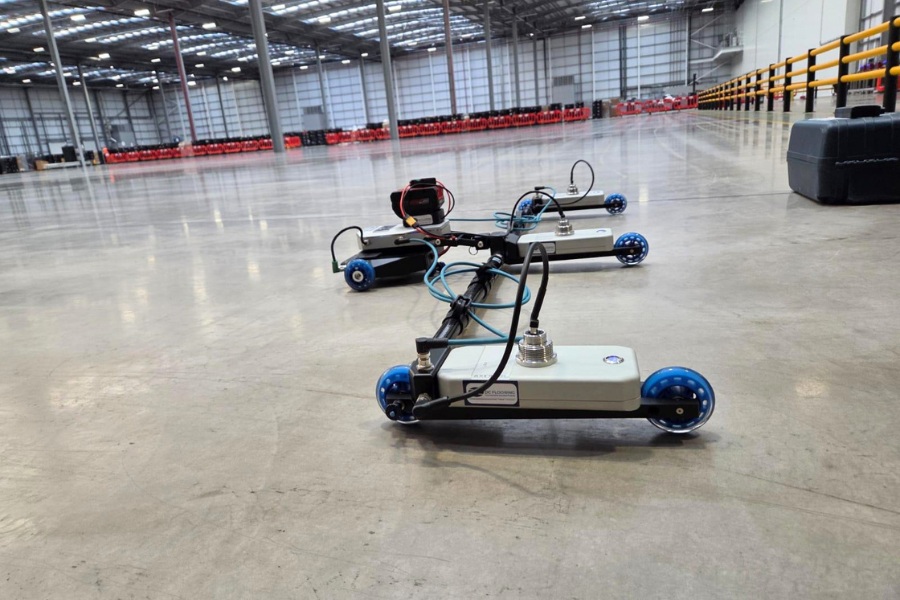
AMRs and AutoStore have different flooring requirements
Both automate the warehouse. They use the floor in completely different ways, and the requirements follow from that.
AMRs
AMRs travel continuously across the building, carrying stock between storage and picking. The floor is not the ground the system sits on. It is part of the operating system.
AMRs need:
- High flatness and levelness along the travel paths
- Consistent surface grip and friction
- Well-maintained joints
- Crack-free travel routes
- Concrete hard enough to take continuous traffic on the same lines for years
- Minimal surface defects
The tolerance that matters here is directional. Survey along the paths, because that is where the wheels go and that is where deviation hurts.
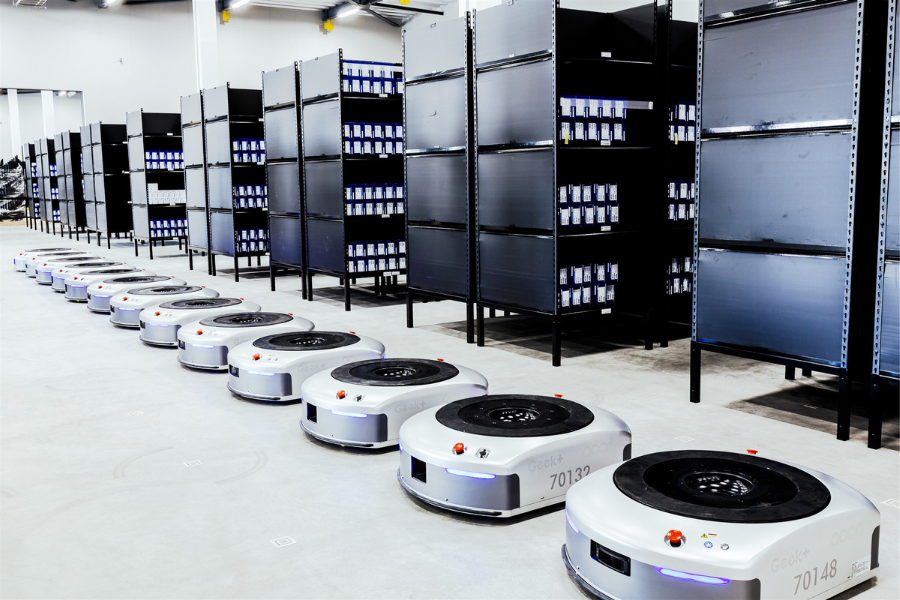
Image credit: Geek+
AutoStore
AutoStore works the other way round. Robots operate on top of a storage grid, bins move within the system, and the floor acts as a foundation rather than a traffic surface.
That changes both halves of the requirement:
- Flatness and levelness tolerances are tighter than a standard warehouse floor, because the grid has to sit true across its whole footprint rather than along a set of lines
- Ongoing wear beneath the grid, once it is installed and loaded, is minimal
It gets assumed the wrong way round, so it is worth stating plainly. A grid asks more of your floor on day one and less of it every day after. An AMR floor asks a reasonable amount on day one and keeps asking for the life of the system.
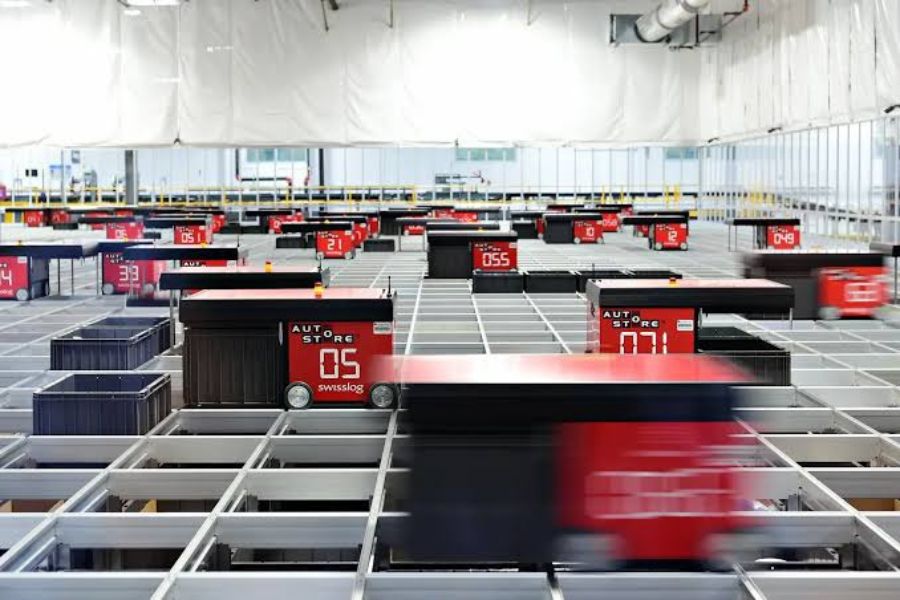
Image Credit: AutoStore
Floor flatness is only part of the picture
Flatness is the number on the tolerance sheet, so flatness is what everybody argues about.
It is one of nine things that decide whether a floor is fit for robots:
- Surface regularity
- Levelness
- Surface durability and hardness
- Joint condition
- Crack width and movement
- Surface roughness
- Slip resistance and friction
- Reflectivity, where robotic sensors read the floor
- Dusting behaviour under repeated traffic
A floor can pass a standard flatness survey and still need work before robots will run on it reliably.
Here is what that looks like on a real job.
We were brought into a robotics installation for a major UK retailer. 6,000m² across two phases, both inside a fortnight. The specification called for ESD performance, floor flatness and a low light reflectance value, and any one of those is the sort of thing you would expect to be the difficult part.
None of them were the reason we were there.
The floor was speced to a minimum Mohs hardness of 5. It tested at 4.
Hardness is the specification nobody photographs and nobody argues about in the design meeting, and it is the one that decides whether the floor is still working in ten years. A floor one point too soft does not fail on day one. It wears, then it dusts, and the dust goes wherever the robots go.
We took it to a hardness of 7 with DCF Express. On that hardness we would expect the floor to hold up without dusting for around 15 years.
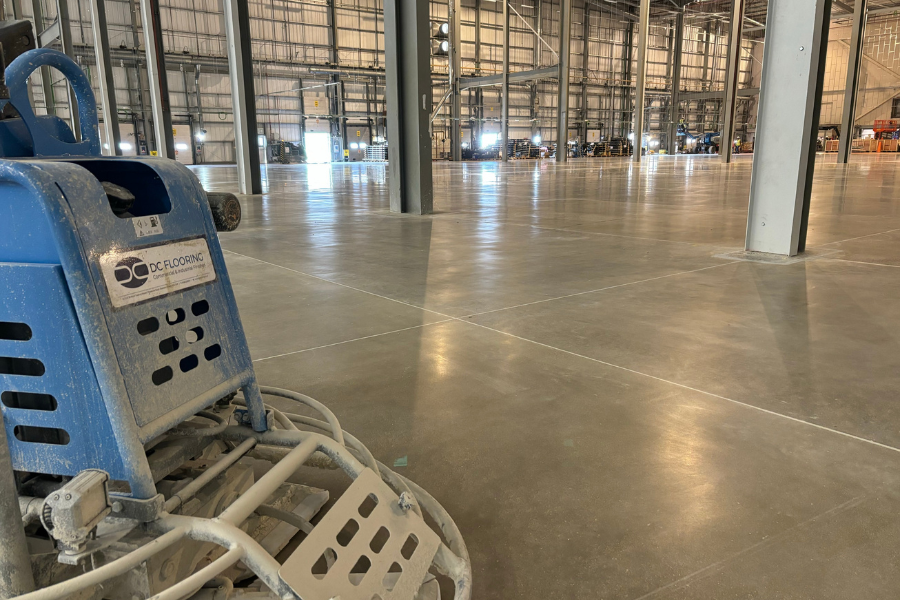
Can existing warehouse floors be upgraded?
In most cases, yes, and without replacing the slab.
What the survey finds decides the method:
- Spot grinding where the out-of-spec areas are small and contained
- Full regrind and re-level where there is too much of it for spot grinding to make economic sense
- High tolerance concrete grinding to correct flatness along defined travel paths
- Joint and crack repairs ahead of any correction work
- Resin or screed overlays where a slab is genuinely too far gone for a regrind to be worth doing
Regrinding is what we push for wherever the slab allows it, because it lasts longer and we can guarantee it fully.
One correction worth making, because it saves clients real money. A floor coming back out of tolerance does not automatically need the whole aisle ground. It depends on the robot specification and the racking height, and both of those change what “in tolerance” has to mean on your floor. We survey first, produce a grind report and a grind plan, then do the minimum work that gets you inside spec.
Why floor testing should come before automation
Testing before installation costs a day. Remedial work after the system has gone live costs a programme.
Once the racking is up, the grid is down and the robots are commissioned, every correction has to be planned around a live operation, out of hours or overnight, in sections. All of that is perfectly possible. It is simply far more expensive than measuring the floor while the building is still empty.
If the survey comes back clean, you have lost a day and gained the ability to hold your supplier to their own specification. Where it comes back out of tolerance, you have found out while the programme still has room in it, which is the difference between a planned correction and a delay everybody is looking for somebody to blame for.
How DC Flooring prepares floors for automated warehouse projects
We test flatness, levelness, hardness and overall surface condition, then tell you what your floor needs and what it does not.
Where correction is needed, we carry it out ourselves. All our machinery is owned and maintained in house, which on a programme running to a fixed handover date is the difference between changing the approach the day the floor surprises us and waiting on a hire company to send different equipment.
“Because DC Flooring installs every major commercial flooring system, we’re not limited to recommending what we know best. We recommend what’s right for your floor, your environment, and your budget.”
On automation floors that cuts both ways. Sometimes the right answer is a resin system, sometimes a polished slab, and sometimes the floor is fine and your money is better spent elsewhere.
Future-proof your warehouse floor
Automation is no longer only about choosing the right robots. It is about giving them a surface that behaves the same way on year ten as it did on day one.
A floor that has been properly tested and prepared runs faster, wears slower and costs less to maintain across the life of the system. One that has not tends to announce itself about six months after handover, when nobody wants to hear it.
DC Flooring is the UK’s specialist in commercial and industrial flooring for warehouses, logistics facilities, food production environments, and automated warehouse systems, with over 20 years of completed projects across the UK and into Europe.
Tell us your floor size and approximate condition, we’ll come back to you with a detailed quote within one working day. No obligation, no sales pressure. Just straight answers.

- AMRs or AutoStore? The robots get months of scrutiny. The floor gets a spec sheet. - August 27, 2026
- Quick Guide to Exposed Aggregate Concrete Floors - June 15, 2026
- Key UK Compliance and Standards for Robotic Flooring - March 24, 2026