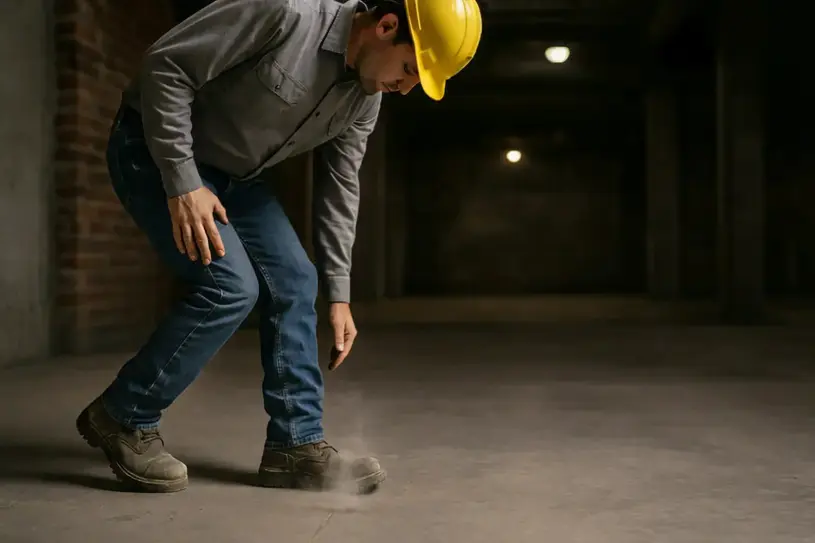
Within the flooring and construction industry, identifying weaknesses in a property’s structure quickly is essential. A heel drop test provides a straightforward way to inspect large areas of flooring, allowing surveyors to assess adhesion without complex equipment. Though simple in nature, it is often used by building surveyors, RICS members, and contractors as a first step before advanced analysis or repair strategies are introduced.
What is a Heel Drop Test in the Flooring Industry?
The heel drop test is a non-instrumented method used to detect hollow or weakly bonded areas within flooring systems. By striking the surface with a firm-soled boot or rubber mallet, the building surveyor listens for differences in sound frequency. Solid floors produce a tight response, while hollow areas create a vibration that signals possible deterioration. This makes it useful across different levels of a survey, from level 1 to level 3 assessments.
When to Use the Heel Drop Test?
A heel drop test is most effective during the early stages of a building survey, particularly when inspecting older buildings where timber floorboards, joists, or overlays might have weakened over time. It is also valuable in listed buildings where invasive methods are not always possible, offering a way to visually inspect and measure risks without lifting carpets or damaging the structure unnecessarily.
- Early Screening: In a level two survey, a heel drop test can be used as a rapid screening tool. It helps to determine whether suspected rot, damp, or poor bonding may be present beneath the surface. This makes it highly practical when a surveyor needs to perform a thorough inspection without moving too much furniture or entering less accessible roof spaces prematurely.
- Site Triage: On active sites, where repairs or inspections are already underway, the heel drop test acts as a triage method. It allows surveyors to prioritise which areas of the floor require further assessment. Hollow spots can be flagged for follow-up, ensuring that time and resources are focused on the sections of the property most at risk of deterioration.
- Pre-Remedial Surveys: Before remedial works, it is important to inspect the scope of the damage. The heel drop test provides an efficient way to assess floor level variations, detect delamination, and highlight where joists or insulation may need closer evaluation. This supports the survey report, ensuring the content of the report is both accurate and aligned with home survey standards.
5 Step-by-Step Procedure to Performing a Heel Drop Test
If you’re wondering how the heel drop test is performed, here’s a quick five-step process that will explain it to you.
1. Prepare
Clear the surface by removing loose debris and, where possible, lift carpets or coverings to gain better access. Mark a logical grid pattern across the floor, spacing points at 0.5 to 1.0 metres. Record baseline photos for the survey report so future inspections can be compared with this assessment.
- Clear loose debris and mark a logical grid (0.5–1.0 m spacing).
- Record baseline photos for documentation.
2. Method
Use a firm-soled boot or a small rubber mallet to apply consistent downward impacts at each marked point. Maintaining the same level of energy is crucial to ensure accuracy. A hammer can also be used to maintain uniform force throughout the inspection.
- Use a firm-soled boot or small rubber mallet.
- Apply consistent downward impacts at each point.
- Keep force and technique consistent throughout.
- Alternatively use a hammer for more consistent energy.
3. Listen and Feel
Interpretation comes from both sound and vibration. A solid or tight sound suggests the structure is well bonded, while a hollow or echoing sound points towards delamination. Surveyors visually inspect and then map these hollow areas onto a plan to help determine where follow-up testing is necessary.
- Solid/tight sound = bonded surface.
- Hollow/echoing sound = delaminated or poorly bonded layer.
4. Map Results
The sounding map records areas as solid, suspect, or hollow. This visual record becomes part of the final survey report, ensuring any future inspections or repairs are carried out with precision. Hollow or weak areas should be highlighted clearly to guide remedial actions.
- Create a sounding map (solid, suspect, hollow).
- Mark hollow spots on a plan for follow-up.
5. Follow-Up
Where hollow areas are identified, further diagnostics should be scheduled. Options include pull off tests, core samples, ground penetrating radar, or moisture testing. These steps confirm the findings, reducing the risk of false positives in the initial heel drop assessment.
Plan targeted diagnostics:
- pull-off tests
- cores
- GPR
- moisture testing
Sound Interpretation Table for Heel Drop Test
| Sound/Feel | Description | Likely Condition | Visual Cue (Icon/Example) | Next Action |
|---|---|---|---|---|
| Solid / Tight | A firm, sharp sound with no echo; impact feels rigid underfoot. | Well-bonded surface layer, good adhesion to substrate. | 🟩 ✅ (Green checkmark icon, floor intact) | Record as “sound,” no further action needed at that spot. |
| Suspect / Dull | A muted thud, not as sharp; may feel slightly “soft” on impact. | Possible early-stage delamination or weak bonding. | 🟨 ⚠️ (Yellow caution icon, floor may weaken) | Mark for further testing (pull-off, cores, or moisture RH). |
| Hollow / Echoing | A resonant, drum-like or hollow sound; impact feels springy or empty. | Likely delamination, voids, or debonding between layers. | 🟥 ❌ (Red cross icon, floor compromised) | Prioritise advanced diagnostics (impact-echo, GPR, destructive sampling). |
Interpretation of Results
Solid and firm sounds usually indicate that the surface layer is well-bonded to the substrate. Hollow or echoing responses point to possible voids, delamination, or dampness within the structure. While effective, the heel drop test is only indicative. It should always be followed up with more advanced methods, ensuring the guidance provided in the final report is both thorough and reliable.
- Solid/firm sound – likely bonded surface.
- Hollow/echoing sound – likely delamination, requiring confirmation.
- Note: Heel drop is indicative, not conclusive -further testing is essential.

Advantages vs Limitations of the Heel Drop Test
The heel drop test is quick, inexpensive, and ideal for screening large floor areas. It allows building surveyors to identify key differences across the floor level and to report back on areas of concern. However, its accuracy depends heavily on operator technique, and it cannot always detect thin or deeply seated delamination. For listed buildings or properties with suspected rot, additional testing is still required to determine the full scope of deterioration.
| Aspect | Advantages | Limitations & Risks |
|---|---|---|
| Cost & Equipment | Fast, low cost, portable, no special tools required. | Limited by operator technique; not as precise as instrumented NDT. |
| Coverage | Effective for screening large areas quickly. | May miss thin or deeply seated delaminations. |
| Decision-Making | Helps prioritise where to core, pull-off, or use advanced testing. | Can produce false positives over voids, joints, or poor pours. |
| Role in Workflow | Great early screening tool to triage slabs, toppings, or overlays. | Not a substitute for pull-off adhesion, GPR, or ultrasonic tests when confirmation is required. |
As you can see, there are multiple advantages of a test like the heel drop. However, there are some limitations, too. It is best used as an early-stage screening tool, especially when you’re looking for a quick and affordable solution. Still, keep in mind that this isn’t a full diagnostic, and you will need to perform more advanced tests to uncover other issues.
Safety and Quality Considerations
- Use consistent impact energy and document the method.
- Wear PPE and cordon off unstable areas.
- Record findings with photos and sounding maps.
Next Steps After Hollow Areas Are Found
After the problems are diagnosed, it’s time to look for solutions. Here are the next steps you should take after the hollow areas are found:
Perform Pull-off Adhesion Tests
Where hollow sounds are detected, pull off adhesion tests in line with BS EN 1542 can be used. This destructive method provides quantifiable results on bonding strength, supporting the wider assessment of the property.
Conduct Moisture (RH) Testing
If damp is suspected, moisture testing should be carried out. Rising moisture can accelerate deterioration in both timber joists and concrete floors, so recording RH levels helps the building surveyor determine the underlying cause of floor vibration or weakness.
Non-destructive Mapping
Advanced non destructive tools such as GPR, ultrasonic, or impact-echo testing allow surveyors to visually inspect below the surface without disturbing insulation or floorboards. This is especially valuable in older buildings or where access to the roof space and structure is limited.
Remedial Strategy
Following the assessment, a remedial strategy should be agreed. This may involve localised cut-out and repair, re-profiling, or removing weak flooring layers and replacing them with stronger materials. The aim is always to restore floor level consistency and reduce risks of further delamination.
Verify with Post-Remedial Testing
After repairs, post-remedial testing should be carried out. This ensures the repair has been effective, providing detailed advice for the client and fulfilling the scope of the survey report.
Heel Drop Test vs. Other Testing Methods
| Method | Purpose | Pros | Cons |
|---|---|---|---|
| Heel Drop Test | Detect hollow spots, delamination | Fast, cheap, simple | Subjective, not precise |
| Pull-Off Test (BS EN 1542) | Quantify adhesion strength | Objective, standardised | Destructive, localised |
| Ground Penetrating Radar (GPR) | Map rebar & voids | Non-destructive, good coverage | Expensive, operator dependent |
| Impact-Echo/Ultrasonic | Internal flaws & delamination | Detailed results, non-destructive | Requires specialist equipment |
Contact DC Flooring for Professional Delamination, Compliance Testing and Expert Inspection
If you need detailed advice or a full survey report, DC Flooring can perform a thorough inspection of your property. Our building surveyors are experienced in assessing different levels of risk, from suspected rot in older buildings to damp in concrete structures. We follow RICS guidance to ensure that your inspection is accurate, reliable, and delivered with professional care.
FAQs
Is the heel drop test recognised by UK building standards?
Yes. While it is not a standalone method, it is widely accepted as an early screening tool within the scope of UK inspections, often forming part of a level two survey.
Can the test detect hidden voids beneath epoxy or resin flooring?
It can identify hollow responses beneath resin or epoxy, though deeper voids may require GPR or ultrasonic methods to confirm.
How do you distinguish between a hollow sound and a surface crack?
A hollow sound resonates with a drum-like vibration, whereas a surface crack creates a sharp, localised noise. Surveyors are trained to measure these subtle differences.
What’s the maximum floor area that can be effectively screened with this method?
Large open spaces can be screened quickly, though efficiency reduces where furniture restricts access. Typically, a building surveyor can cover hundreds of square meters in a day.
Do surveyors accept heel drop test results as evidence of inspection?
Yes, but only as part of a wider assessment. A heel drop test should be supported by further diagnostics in order to meet the RICS home survey standard.
Does flooring warranty get affected if delamination is found late?
Yes. Late detection can complicate claims and remedial responsibilities. Regular inspections help protect warranties and reduce the risk of unexpected repair costs.
Can a heel drop test be used in combination with acoustic sensors for better accuracy?
Yes. Pairing heel drop tests with acoustic sensors helps quantify natural frequencies and vibrations, making the inspection more reliable, especially in older or listed buildings.

- Abrasion Resistance: Why It’s Critical for Industrial Floors? - November 11, 2025
- The Heel Drop Test: A Fast and Simple Way to Detect Delamination - October 30, 2025
- How a Cover Meter Survey Protects Reinforcement Integrity? - October 28, 2025