
Something is going on that floor. It has to bond to what is already there, or the floor has to be flat, or both.
Somebody tells you it needs grinding. That one word covers four different machines doing four quite different things to concrete, and they are not interchangeable.
Pick the wrong one and you are paying for preparation that will not do the job, or for days of machine time the floor never needed.
Start at the end, not at the floor
We do not start by looking at what is on the slab. We start with what is going on it afterwards.
Is a coating going down? Does the floor need to be flat to a measured tolerance? Will a pump screed need a profile to grip onto? What the floor has to hold, and what has to bond to it, decides the preparation. Everything else follows from that.
That is also why the same floor can genuinely need four different machines depending on what you are doing with it.
Four machines, and what each one is actually for
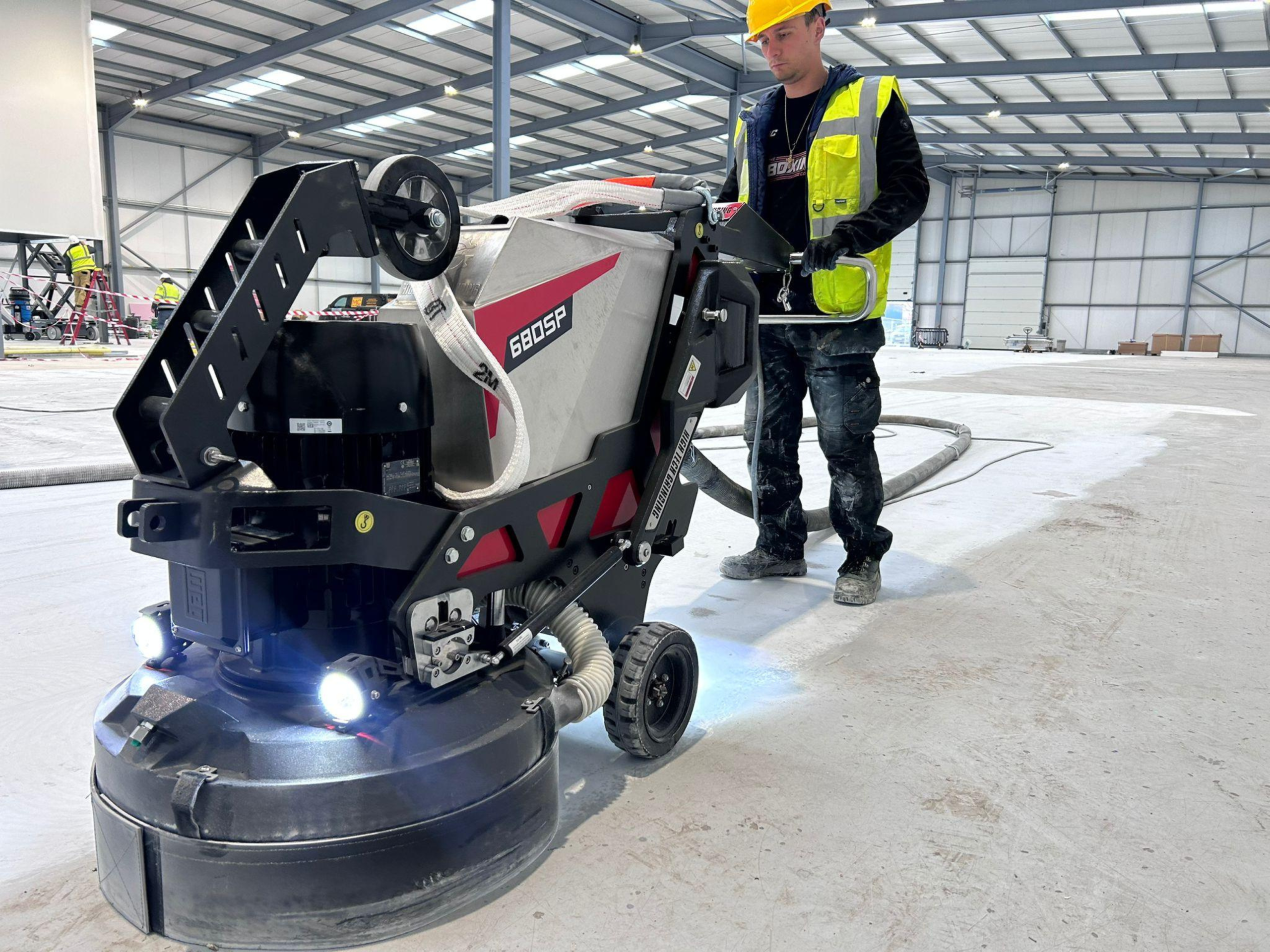
Diamond grinding: The one most people mean when they say grinding, and the one whose purpose changes most depending on what the floor is for. Where a floor is going to be polished, diamond grinding is the first step of the polish. For a resin or cementitious system going down, it is how we create the mechanical key that system needs to bond to. If flatness is the objective, it follows a level survey and works to the numbers that survey produced. Three different jobs, one family of machine.
That family is large. Single fixed head machines up to four-headed and planetary ones, running wet or dry, from small 110 volt units to large three-phase machines. The tooling decides the aggression: PCD tooling rips up old levelling compounds, metal bond diamonds take a surface down.
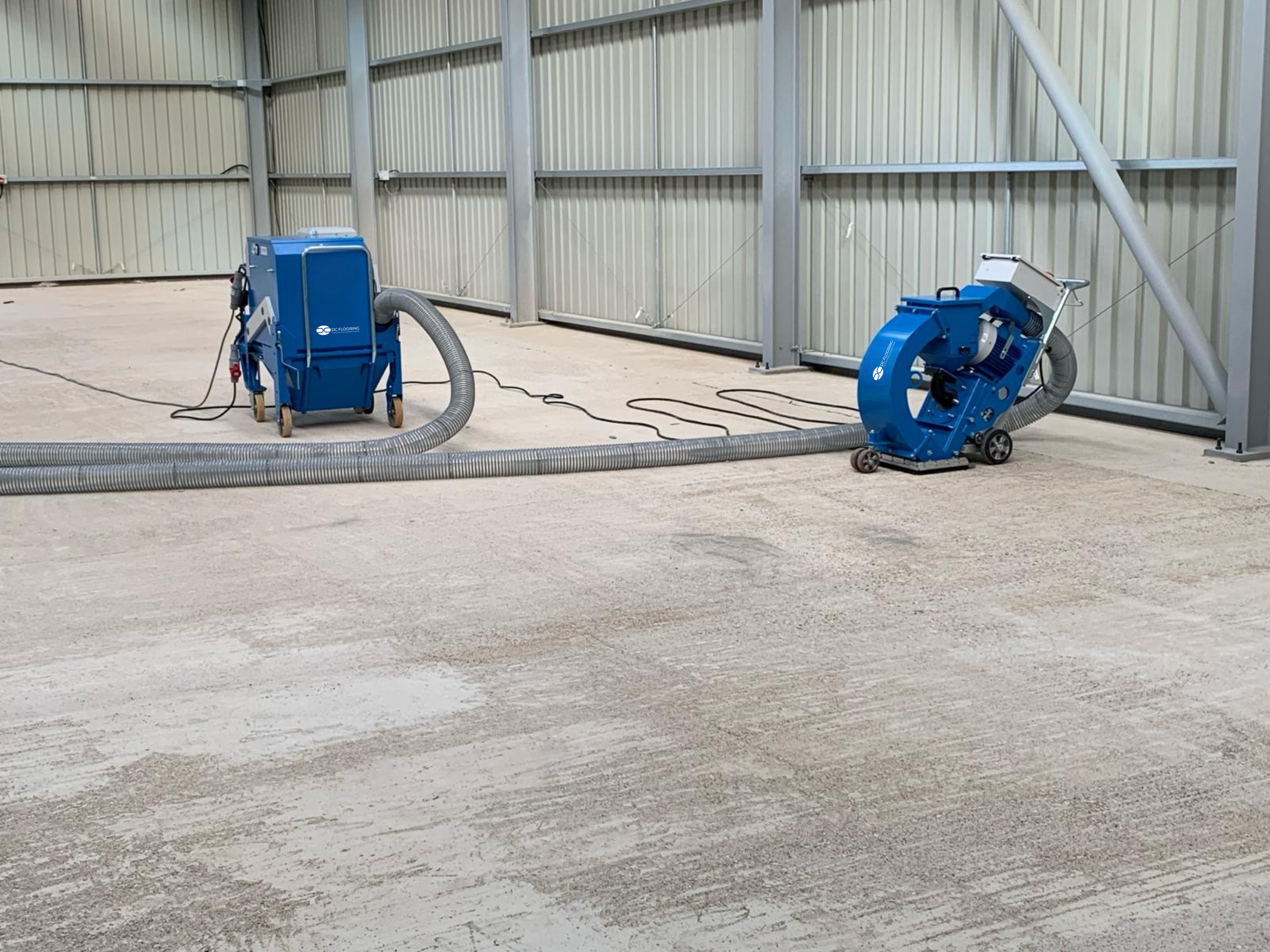
Shot blasting: A different process with a different output. The machine fires steel shot at the floor, cleaning it and leaving a mechanical profile rather than a smooth surface. How deep that profile goes depends on the shot size, how openly it is blasted, and the hardness of the concrete underneath. It can leave blast track lines.
Where it wins is speed. A good shot blaster covers 2,000 to 4,000m² in a day, considerably more ground than a standard diamond grinder will manage, which makes it the cost-effective choice across a large area.
Where it is the wrong call is thin film systems. A shot blasted floor is rougher than a ground one, so a thin epoxy coating laid over that profile will show it. Shot blasting suits systems with real thickness, roughly 4mm and upwards, where the material fills the profile rather than following it.
One other use worth knowing. On a floor that is not smooth, a diamond grinder only takes material off the high points and leaves the low ones alone. A shot blaster takes it off everywhere, as long as the floor is not too wavy, which makes it the better tool for stripping coatings off an uneven floor or taking line markings out.
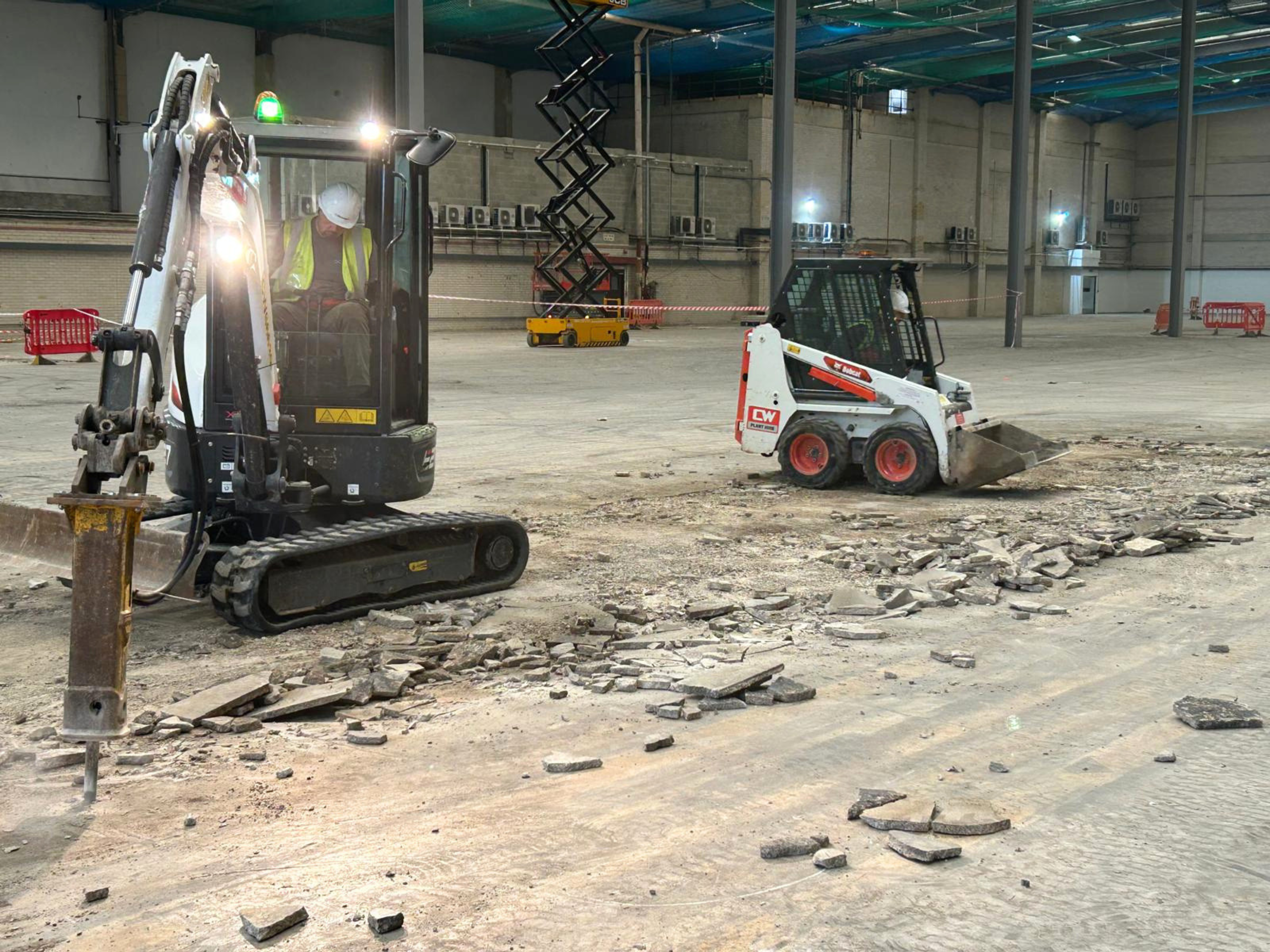
Scarifying, also called shaving or planing. A milling barrel holds multiple blades that cut into the slab, and the cutting depth adjusts up or down. This is the machine for real depth, in the region of 6 to 10mm, and it leaves a heavy profile behind it. Reach for it rather than a diamond grinder when material has to come off properly, particularly on a very hard floor where a grinder would get there eventually but would be a long time doing it.
Scabbling: Another heavy profile, from a completely different mechanism. Metal cogs hit the floor repeatedly and tear into it, which is what takes thick existing resin or coatings off. What it leaves behind needs either a thick system over the top or a heavy diamond grind to bring it back to smooth, so it is never the finishing step.
Shot Blasting
The three scopes: spot, full, and full aisle
Three different scopes, and the difference between them is where most of the money sits.
- Spot grinding: Grinding in specific, localised places. It usually follows a level survey, where particular points on the floor have come back outside tolerance and only those points need correcting.
- Full grind: Grinding the whole area, whatever size that area is.
- Full aisle grind: Tied to a level survey for defined movement. Where a VNA aisle is a long way out of tolerance, sometimes the whole aisle has to come down. We have the machinery to do it and we do it when it is needed.
Here is the part worth knowing before you settle on a method. A full aisle grind costs a great deal more than spot grinding, and a lot of the time it is not necessary.
Some companies push towards the full aisle grind because they own the machine and it is an expensive machine to own. Survey the floor properly first and you often find you are touching a few small areas rather than the whole run. We would rather produce the grind plan, do the minimum work that gets you inside spec, and pass the difference back to you.
A floor that looks flat is not flat
This is the thing clients are most often surprised by, and it is worth saying plainly because it changes what you can reasonably expect.
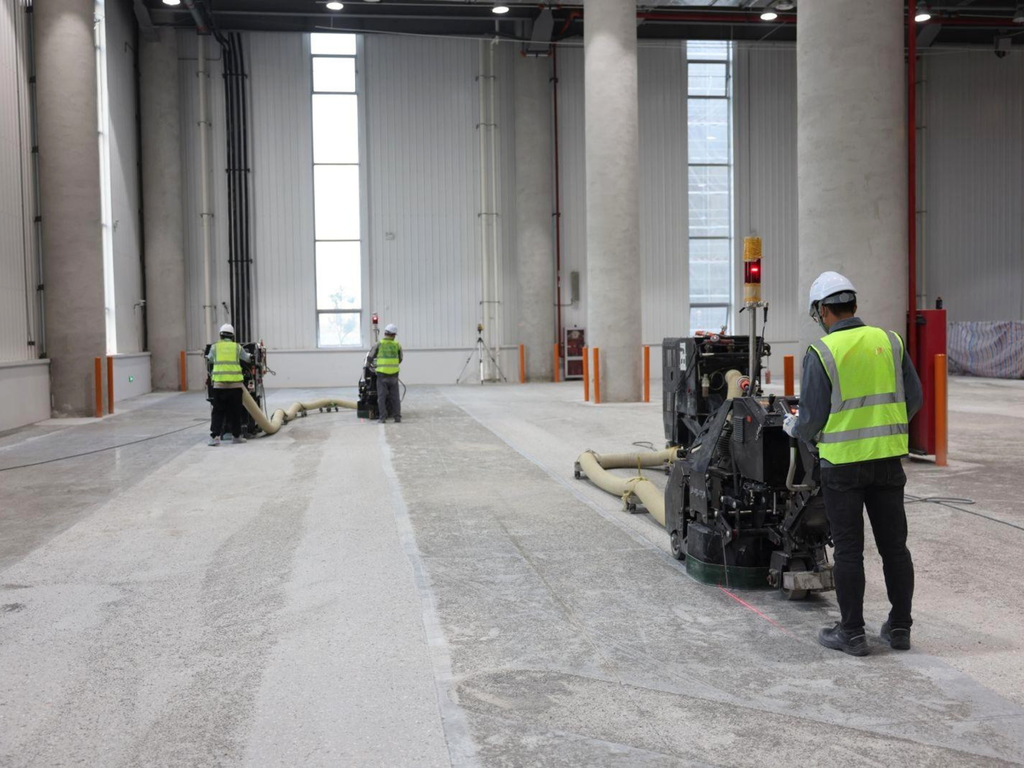
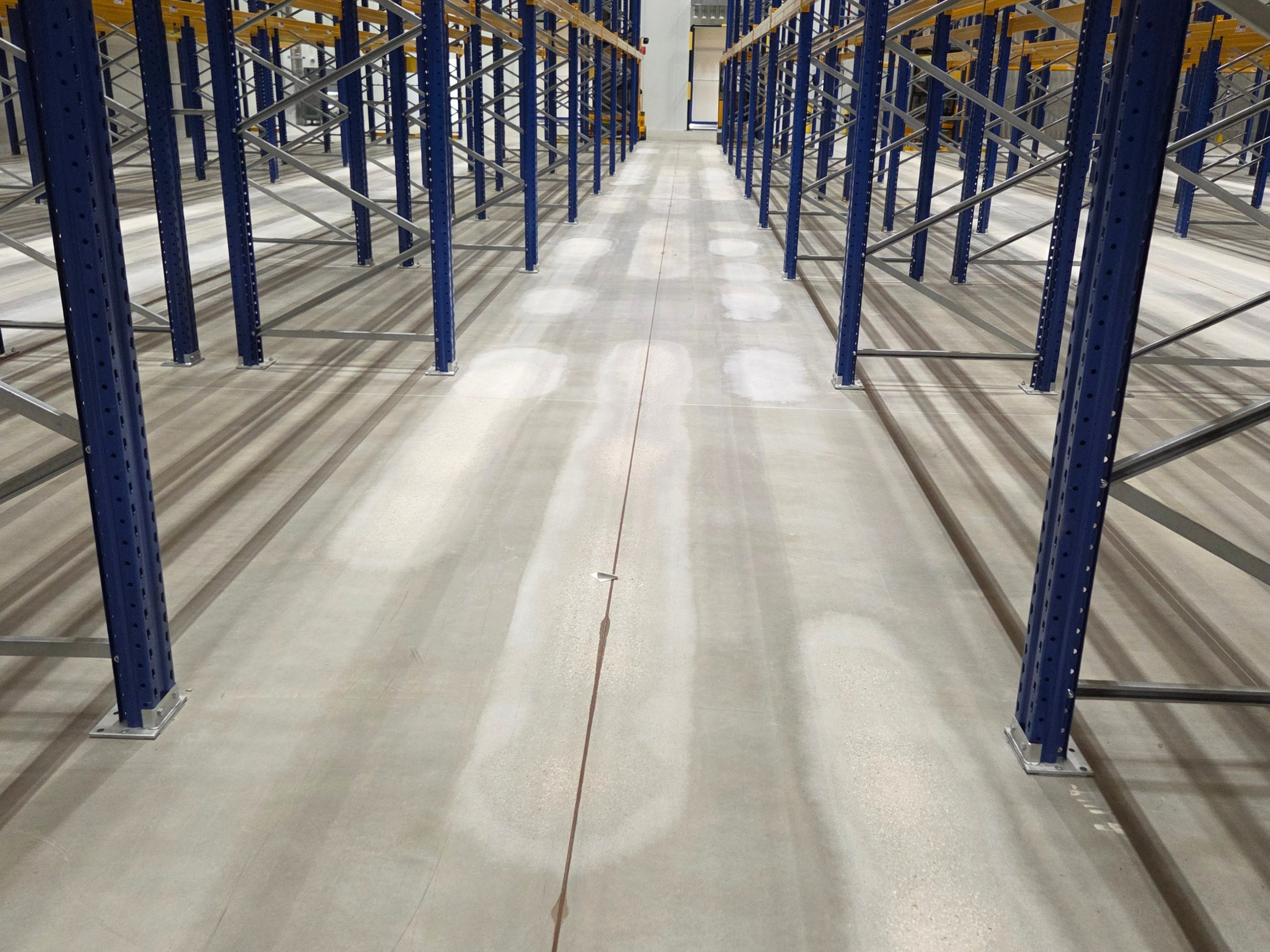
Concrete floors are never laid perfectly. A planetary grinder passing over one does not make contact with every part of it, so it leaves small dips untouched where the surface already sat low. Getting a genuinely uniform finish across a whole area is close to impossible unless the slab underneath was perfect to begin with, and it never is.
The same waviness shows up in the finish itself. Where the machine has cut deeper, more aggregate is exposed, so the appearance changes across the floor even when the tolerance is right.
None of that stops a floor meeting a specification. It does mean that a quote promising a perfectly even finish across an existing industrial slab is promising something the concrete will not give.
One floor, corrections from half a millimetre to fifteen
We surveyed an automated warehouse for a robotics client, aisles running to around 100 metres. Roughly 30% of the floor area came back outside specification.
The corrections ranged from taking half a millimetre off in some places to 15mm off in others. Same slab, same survey, same day. We used a combination of spot grinding with diamond grinding machines and concrete planers to deal with the range.
That spread is the reason none of this can be quoted from a photograph or priced as a rate per square metre. The floor decides the job, not the floor area.
When grinding is the wrong answer
Sometimes it is, and the most common case is a thick resin system that has to come off.
Put a 6mm or 8mm polyurethane screed in front of a diamond grinder and you will be there forever. Grinding through it is close to impossible as a practical matter. That is a scabbling job, and trying to do it with the wrong machine costs days rather than hours.
How much concrete can you actually take off?
It depends on the floor, and past a certain point it stops being a flooring question.
Every concrete floor is built differently. Some have metal mesh in them, some have steel fibres, and what the floor has to carry matters as much as what it is made of. A high-bay warehouse carrying significant weight at specific points is not a slab you can simply take material off.
As a rule of thumb, if more than about 10mm is coming off and the building is anything other than a standard warehouse, a structural engineer would normally be involved in that decision. That is not us being cautious with somebody else’s building. It is the one part of this work where getting it wrong is not a finish problem.
Why we survey before we quote
A floor can come back inside tolerance and need nothing at all. The same building can turn out to need the whole area taken down and re-levelled. Until somebody has measured it, any number is a guess with a quote wrapped around it.
Our profilograph takes a reading every millimetre, where most competitors sample every 50mm, and it produces a grind plan rather than a report: where to rectify, and what to take off. Data from one pass converts to TR34, DIN or another standard without going back to re-survey, which matters when a specification changes mid-project.
All our machinery is owned and maintained in house, which on this work matters more than it sounds. When a floor turns out differently from what the survey suggested, we change the machine that day rather than waiting on a hire company.
“Because DC Flooring installs every major commercial flooring system, we’re not limited to recommending what we know best. We recommend what’s right for your floor, your environment, and your budget.”
On grinding that cuts both ways. Sometimes the honest answer is that the floor is inside tolerance and the money is better spent elsewhere.

- Know your warehouse floor: was it built to FM or SR, and does that still matter? - October 21, 2026
- Concrete floor grinding: four machines, four different jobs, and the one your floor probably does not need - October 15, 2026
- Resin flooring: Epoxy, PU or MMA, and why the system you pick is not what decides how long it lasts - October 14, 2026
